Home About Me My Store Freebies Pinterest Facebook Instagram TeachersPayTeachers Email Twitter Image Map
Showing posts with label Back to School. Show all posts

Morning Meetings for Upper Elementary Students

Morning Meeting for Upper Elementary Students
Who loves a Monday Morning Meeting?

I am not talking about a staff meeting or another round of PD. This meeting is completely kid-centered and exciting for everyone involved. My team and I arrange for bi-monthy team meetings. Twice a month our grade level - 3 classes - reserves our auditorium for the meeting that kids constantly ask for.

It does take some planning and teamwork between the teachers. But as each month (and year) has gone by we have gotten faster at planning and better at execution each time. We have happily reached a point where we can throw a Monday Morning Meeting together quickly. Here is how we do it...

What You Need to Host a Monday Morning Meeting:

  • Meeting Space (large enough for your group)
  • Posted Agenda (I use a set of Google Slides that I edit each month and they are projected onto a large screen in our auditorium)
  • Materials for Planned Activities

You can hold Monday Morning Meetings with just your class, but these meetings become even more powerful when you have multiple classrooms participating. Students get an opportunity to work with other students they may not see except for a few minutes during lunch, recess, or on the bus.

If you don't have any grade level teachers willing to participate, grab a class from above or below your grade level. There must be someone willing to spend quality time with you and your students! An added bonus of multi-grade levels is the connections being made at a building level; that's pretty special.

When planning and organizing your first few team meetings, think of a structure that you will use over and over again. It helps the students understand the expectations and keeps the meeting organized and focused.

This is the structure my team and I use:

  • Students get off the buses and walk straight to the auditorium (We love to see all of their faces light up as they start their day in the auditorium!) 
  • Sit by homeroom in your assigned section
  • Opening (announcements, pledge)
  • Team Chant (sung to "We Will Rock You")
  • Go over the agenda
  • Complete an activity/team-builder
  • Close with an inspirational message

Team Activity Ideas

When planning for team activities, we like to really mix up. We never do the same activity twice. That keeps it fresh and exciting for the students. It also helps them develop following directions (we project the directions so students can reference their task as needed). We also like to plan for seasonal fun whenever possible. And, we love it when the team activity relects back on content learned in the classroom. Here are some team activities we have done in the past:

Who's In Your Circles?: Students get a response sheet with concentric circles labeled with things such as "food", "subject", "hobby" on the inner most circle. The circles moving outward are labled with "I love this.", "I like this.", "I don't like this." They complete the response by filling in their favorites. We then break students into small groups (3-4). They get together and take turns talking about their response. Students jot down the names of students who love, like, or don't like their given response.

This activity is great for establishing norms of group work and giving the students a chance to get to know one another. This activity is done in the opening month of school. More than likely, students will be grouped with students they do not know. It's a perfect ice breaker for upper elementary and middle school.

Index Card Favorites: Each student gets an index card. In the center of the card they write their name. In each corner they write 3 answers to given topics. For instance: 3 Hobbies, 3 Favorite Foods, 3 Favorite Movies, 3 Adjectives to Describe You, 3 Placed You Would Like to Visit, 3 Favorite Animals.

Once the index card is filled in, students mix and mingle sharing their answers with different students. This is another great team-builder where students are practicing their speaking and listening skills.

Team Meetings for Upper Elementary

Candy Corn Bottle Flipping: The loudest (and most fun!) STEM project we bring to morning meeting is our candy corn bottle flipping. The teams predict which of their 4 bottles is easiest to flip based on the amount of candy corn in them. Students take turns one at a time flipping and record results. Preparing the bottles took time, but once they were done they are easy to store until the following year. We use the candy corn section in October STEM Activities from Lisa Taylor Teaching the Stars.

Pumpkin Glyphs: This one is SO MUCH FUN! We took the directions designed for an individual glyph and had the students create a team glyph. The results were outstanding and made for an eye-catching holiday hallway display!

Read all about them here: Best Collaborative Actvities for Hallway Displays

team building pumpkin glyphs

Human Christmas Lights: In groups of 7-8, students link hands with a person not next to them and untangle themselves without letting go of each other’s hands. They should hold the hands of two different people. It can be tricky and some students release their partner's hand in desperation to untangle. But that's ok, just have them start again! Students like to do this activity over and over again because, once they understand the strategies used to untangle, they like to explore them repeatedly with different entanglements.

Holiday Book Exchange: We like to have a Morning Meeting before the break where students do a book exchange. We send home communication to families asking them to send their child to school with a new book (no more than $5) wrapped and labeled with a to/from tag indicating if it's for a "boy", "girl" or "either" and their child's name.

The teachers collect books all week long before the meeting. We do keep some extras on hand and wrap them if a student is unable to bring a book in for the exchange. You can also add a few extra in so the last handful of students that pick have more than 1-2 options.

The entire grade level sits in a large circle on the stage. We sort the books in the middle of the circle into 3 piles by category (boy, girl, either). We then randomly draw names to determine the order that students go into the middle to pick their book. Students are instructed to sit with their book and wait until every student has chosen a book. Once everyone has their books, we open! We remind students to read the label (so they know who to thank).

Once books are opened, we spend a few minutes cleaning up the space and remind students to find the student who gifted the book the received and thank them personally.

Digital Fun: We have had our students bring their Chromebooks to the auditorium. Once there we will have them complete (or compete) using digital platforms. One thing to consider is if your space can connect to a decent signal and handle the bandwidth. It's discouraging when some of the Chromebooks are functioning smoothly and others are unable to keep up.

Some platforms lend themselves to working in pairs or small groups on one device. Kahoot and Quizlet Live are a couple of our favorites.

Plickers is also fun. It's an excellent way to get students engaged while running a quick formative assessment! I have noticed that running the app does drain my phone battery a bit, but I think it is well worth it.

Other Activity Ideas

Positivity Project: Representing Positivity Project in our meetings is also a great way to start their week. The feel good quotes and videos provide opportunities to reflect on ways we are making a difference in our relationships with others. We have focus words and concepts that we infuse into our week, but this is a great place to discuss it as a grade level.

Invite an Expert: Guest speakers are an amazing way to create a community/school connection. We had a local military foundation come in and speak to the students. Her discussion on therapy dogs for veterans ignited a community project that went school wide. All of our students donated dog treats and supplies that we later donated to the military foundation. 

One time we has an expert in Tourette Syndrome come in and present to the grade level. Because we routinely met as a grade level, it was an easy to determine a date for her present. Another time we had a person give a lecture/slide show/demonstration about the battle of Bunker Hill during our Revolutionary War Unit. Again, it was easy to schedule because we already had the dates and space arranged.

Reward System

To build excitement at our meetings and to connect with what goes on in the classroom, we started a ticket system. The students love the ticket system! When our students get caught during the week doing something great academically or socially we reward them with a ticket. These tickets are placed in a grade level bin that grows throughout the month.

At the end of the last meeting of the month, we randomly choose winners. Students choose from small prizes and rewards. The favorite prize is a lunch bunch date in the classroom for them and 3 friends. You can stop at the dollar store and grab seasonally fun items. For instance, during Halloween time we bought small fidgets for prizes as well. We try and make these prizes easy and exciting for the kids.

Morning Meetings for Upper Elementary Students

Who would have thought such a simple addition to our schedule would make such an impact! The students know that the meetings are fun, but they have no idea how powerful they really are! Try and have a meeting with just your class to start off small. It really is an amazing way to connect to your kids!

Other Blog Posts You May Be Interested In:

Ways to Use Picture Books in an Upper Elementary Classroom

Easy Back to School with Picture Books

Best Collaborative Activities for Hallway Displays

Easy Lesson Plans

Questioning Techniques in an Elementary Classroom


Morning Meeting for Upper Elementary Students

Reading Response Journals

reading response journals in an elementary classroom
Research has proven over and over again the importance of sustained silent reading. We have all seen the Read 20 Minutes a Day Chart; and some of us have handed them out to families each fall at Meet the Teacher Nights, Fall Parent/Teacher Conferences, and many other times of year. The reality is that very few students will read 20 minutes a night. They aren’t getting huge chunks of time to silently read. They aren’t getting huge chunks of time to imagine the settings and characters. They aren’t getting huge chunks of time to truly dive in and immerse themselves into a novel. So, what can we do?

Most of the educators I’ve talked to simply do not have 20 minutes of time to allocate toward silent reading. The schedule is so jammed-packed with required curriculum, we have very few minutes left to build unique learning opportunities. And even if we do find a few minutes a day to squeeze in an independent read, how can we make sure the students are held accountable for that time? What can we do to make sure we have “real readers” and not “fake readers” sitting at the desks?

I use Reading Response Journals.

Students will need the following:

  • Composition Notebook (one per student)
  • Pencil
  • Novel

Teachers will need the following:

  • Colored Pen (I use red)
  • Date Stamp (optional but a fun way to make your response “official”)
  • Stamp Pad
  • A storage container for the journals (You can have students keep them in their desks…but that’s not a risk I’m willing to take.)

reading response teacher tools

To keep my students accountable for their individual reading, I ask them to write to me about their text. Each response requires:

  • Friendly Letter Format
  • Date
  • Greeting
  • Thinking Code Response (at least 2)
  • Closing
  • Signature
After the first few days of reading response, I noticed that the students required a bit more modeling and support with what a reading response should look like. I modeled a reading response on the front board as I referenced the new anchor chart on the wall. I noticed a big improvement right away; and the students have been getting better and better each response.

reading response anchor chart

Why Composition Notebooks?

As part of their school supplies, I ask students to bring in a composition notebook. They are just the right size for reading response and store beautifully. They are compact, and won’t tangle while in storage. (If you have ever tried to store a set of spiral notebooks the students take in and out of a bin throughout the year, you know what I’m talking about.)

reading response journal storage


What are Thinking Codes?

Thinking Codes are a system of codes written on sticky notes that students place in their novels as they read. These codes become a brainstorming for later on when they write about their novels. It helps students to know what to write about and helps to combat the, “I don’t know what to write” issue that some students run into when responding about text.

thinking codes anchor chart

thinking codes bookmarks


thinking codes in a novel

I use thinking codes with all kinds of texts and lessons. Students are expected to code text during regular classroom instruction as well as independent reading. During classroom instruction, students will code directly on the page within the text. For novels (and other text they cannot write on, they will use sticky notes). There is always a stack of Thinking Code Bookmarks ready and waiting when students need a new one.

Why Red Pen?

I use a Red Pen. This generation doesn’t seem as scarred by a red pen as previous ones. In truth, I use a red pen for a couple different reasons. The first is that my stamp pad (which I use to stamp the date) is in red ink. So, I want my writing to match the stamp color. Second, using red helps the students to see where I have responded. Although the majority of my responses are simply a continuation of the conversation, I sometimes (rarely) go back into the students’ responses and make notes or comment.

How Do I Keep Reading Response Organized?

To start, I post anchor charts that help my students understand the expectations. One chart is the actual schedule. My building runs a letter day schedule (A-F). Yours may use something different. Whatever the interval, plan out the days and assign one set of students per day. It’s important to keep the schedule “light” so that you only have a handful of responses to read and respond to each day.

reading rsponse anchor chart

I have another chart that explains the different between a Real Reader and a Fake Reader. At the start of the year, I go over each bullet point of the chart and discuss how it’s important to be a Real Reader. When I first heard about this strategy to get students to actually read, I scoffed at it. But, i gave it a shot and was surprised at the positive reaction and response. It did help the "fake" readers turn a corner to real reading.

real readers versus fake readers anchor chart

Troubleshooting

It’s important that students are choosing their own novels for Reading Response. One great way to expose them to a lot of different genres and authors is to host a book tasting. Book Tastings are the best! I love to host them 2-3 times a year. The students have an opportunity to sample different books and they walk away with a pamphlet of ideas they can refer back to when they are choosing their next text. 

See how I run a Book Tasting by clicking here.


One trend I have noticed the past couple of years is the drastic increase in graphic novels. They are visually appealing and tell a story faster. With that said, they leave little work on the part of the student. Readers do not have to imagine the look of the characters or the settings. The comic book style dialogue also means that the sustained silent reading we are reaching for is “cheated”. That translates to students who can lose interest and give up when they encounter text that is denser and more challenging. 

If you have a student that has not selected a classic chapter book, I highly encourage you to highly encourage them to do so. This is the deal in my classroom: one graphic novel, then one chapter book, then one graphic novel, then one chapter book. We keep it balanced, yet fun. 

Have students choose a response and re-work it into a book talk. Reading responses offer a framework for students to build upon. If the students have been putting in the work and following the format of reading response, there won’t be much more to shifting the responses to a book talk. Try to designate a few minutes (maybe once a week) for students to book talk with one another about the novels they are reading.

To get the students truly invested in this process, you need to be as well. Respond back. Ask questions that challenge the student to thinker deeper about the text. You don’t need to know the novel to be able to respond in an engaging way. Some of the questions that are my “go to” if the student isn’t giving me much to work with:

  • Who is your favorite character? Why?
  • Which character reminds you of someone you know in real life? Why?
  • What do you predict will happen with _____________?
  • Why do you think _________ decided to___________?
  • How does this book compare to (another book by the same author)?
  • What has been your favorite part of the book so far?

Reading Response Journals Ella Enchanted
One of the best!
Reading response journals are a unique way for students to engage with text they like. As a teacher, I love to read the responses. It gives me insight to what they like to read, the characters they are drawn to, and the authors/genre they prefer. Reading response journals also give me a chance to have a 1-to-1 conversation about books with individual students. Sometimes the student and I chat about the same book for a couple of weeks, other times, it’s a one and done. But, regardless of the length, the friendly letter format and constant read and respond make for some wonderful opportunities to connect.

Other Blog Posts You May Be Interested In:

How to Host a Book Tasting in an Elementary Classroom

Friendly Letter Writing in an Elementary Classroom: Friday Family Letters

reading response journals in an elementary classroom

Back to Basics in an Elementary Classroom

back to basics in a post-covid elementary classroom

I've been teaching for over 20 years. It's never been like this. Ever. Some of my hardest weeks occurred in the last 2 months of school (and I taught during a lockdown and subsequent remote/hybrid teaching the following year)!

When people ask me what it's like in the classroom right now, it's very hard to articulate the experience. Many people assume that because we are back to "normal" that everything is normal. It's not. I oftentimes tell people it's a "different kind of chaos". So, what's going on?

I've thought about it and I've come up with some ideas. But, in a nutshell, the basic views of school and the expectations we sometimes think are natural or ingrained in our students simply no longer exist. In seeking solutions, I've tested out some techniques and approaches to getting students back to the basics of school.

Use Simple, Basic Rules


My rules have evolved over time. At this point in my career I have whittled them down to the 4 basic rules listed below. Pre-Covid, students understood these rules. Posting them and occassionally reminding students of the rules was enough to keep classroom behaviors in check. Post-Covid, students need a little more support.

1. Follow Directions Quickly
2. Raise Your Hand for Permission to Speak
3. Make Smart Choices
4. Keep Your Eyes on the Target

At this point, students need more than occassional reminders. Some days we will pause and discuss a rule at length with specific examples of what it looks like in a clasroom. I will also thank students when they follow the directions. For example, "Thank you, Jane, for raising your hand." or "I love that you have your eyes on the target, John." It can be exhausting to constantly affirm when students are following directions. But, it helps remind students of the expectations for following the rules and gives a bit of praise to those who are already doing it.

Start with One Step Directions


My students are struggling with following directions. I no longer give more than one direction at a time. Some days that means I need to start with, "Put a pencil in your hand." Yes, that sounds extreme, but that's the reality. I've also implemented a lot of pointing and checking during directions and instruction such as, "Put your finger on the word 'directions'" or "Put your finger on number 1." 

Having the students point to and physically work their way down the page helps keep them focused. It also helps teach them how to navigate a page. For many students they have been working on computer screens and platforms which have been automatically turning pages or advancing through question sets. For my students (and maybe yours), they haven't had to physically navigate through worksheets or packets in quite some time.

By giving one step directions I can also make sure everyone is pacing together. It keeps me pacing at a correct rate and gives the students the support needed to stay with me during the lesson. It has slowed me down; which is a good thing. The students sitting in front of me cannot work through the content at the rate my students could in 2019. There are too many gaps: educationally, mentally, socially, etc... I anticipate the need for one step directions for the next couple of years.

Practice Basic Expectations


WALKING IN A LINE
I worked with my students for 180 days. They still struggled with walking in a line. Fourth Graders. Struggling. Walking in a Line. I even practiced with them- extensively. Like, we would take 4 loops around the building to practice. And they still struggled. I have no explanation for why it was such a struggle. But, I will be reviewing the exact fromation that is expected: hands by sides, walk in front of or beind - not next to, alphabetical order.

AUDIENCE MANNERS
In-person school assemblies took a hiatus during Covid. We used the power of video and live stream to get together as a building. We did get together in the auditorium as a whole grade level before the end of the building. But, students have been passive audience members for a very long time. They need to learn and adjust to what it looks and sounds like when you are a live audience and there is something being presented or performed on a stage in front of you. Making noises, calling out, shuffling around, or leaving your seat may be acceptable when you are seated behind a screen and can mute the mic and turn off the camera. However, it is not when seated in an auditorium with a couple hundred people seated around you.

Students need to learn how to sit and attend. To get my students better prepared for sitting in a large auditorium, we will practice sitting attentively and quietly in the classroom. I plan to start will shorter videos (such as a BrainPop) and build their stamina.

HANDS TO YOUR OWN BODY
This one is always a struggle. It continues to be. Even post-Covid some students need to be reminded every day to keep their hands (and feet) to their own body. This is reflected in Basic Rule #3: Make Smart Choices. My fourth graders know the rule- most elementary students know the rule. We still need to remind and practice keeping our hands to our own body.

TAKING TURNS
Taking turns is one of those skills that is oftentimes taught and practiced in the primary grades. In a post-Covid world, the students walking into the classroom have not had the practice. I plan to use a lot of tangible ways to help students remember and navigate taking turns.
  • Talking Trays: One way I use talking chips is to get a dollar store tray and place numbered chips (1-6) inside the tray. Each student is assigned a number and they are given a certain number of chips. As they chat and participate in the group discussion, they place a chip from the outside section into the middle. The chips help students keep track of who has spoken and who still needs a turn. When all of the chips are in the center, students can re-sort and start the process over. See Talking Trays in this blog post.
  • Speaking and Listening Cards: Students work in pairs with this activity. I go over the expectations and model the first couple of exchanges. If students see the behavior and activity modeled, they will have better success when completing it with a partner. Students are given sentences starters and prompts to help them become familiar with the process and engage in meaningful conversation. You can get a FREE set of Speaking and Listening Cards in my TpT Store. 
speaking and listening task cards free

  • Getting to Know You Games: Students love to play games. My students especially love games where they get to talk about themselves. Why not combine taking turns with some speaking and listening and a little game board fun? I usually play some getting to know you games in the fall to set the expectations. I keep the groups to no more than 4. And, I usually play these games after we have done a couple rounds of speaking and listening cards. (I plan these activities throughout the whole first month of school.) Once the students are familiar with the format and expectations, I will leave Getting to Know You Games in my sub plans (when necessary). See the games I use here.

back to school boaird games 


Grit


When we were remote/hybrid it was tempting to close a chromebook when the struggle became too much. Too many students gave in, closed the computer, and did not re-engage in the lesson. After a couple of years of this practice, some of my students were now faced with all day instruction where there wasn't an escape from the productive struggle required for growth. This lead to more meltdowns and shut downs than in previous years. 

Many, many (did I say many?) times I had a student walk up to me and stand there with an open Chromebook. Sometimes they expected me to be able to read their minds, or look at the screen and know what the problem was. We spent a lot of time as a classroom community discussing how to articulate frustrations and explain where the exact breakdown in understanding was happening. It was difficult to near impossible for some kids. 

To help get the communication going, I oftentimes had students start at the beginning and asked them to walk me through what they had completed. If they struggled with that, I would begin by starting with the first part of the activity or assignment and ask them yes or no questions. "Do you know how to..." "Do you understand how to..." "Where you able to..." I would also ask them to "tell me where you are" or "what is the next part you need to work on?" 

I was also careful with my word choices. I avoided using the word "can't". I would use phrasing such as: "Where's the hiccup?" "Which part is the biggest struggle right now?" "How can I help you?" "What have you tried?"

Using affirming language also helps ease tensions and discouragement. "We'll try it another way." "Let's see if we can get this figured out together." "Please ask for help, that's why I'm here." "Yes, it's hard. That's why you are feeling a bit frustrated- we are trying something new." "Trust yourself, you can do this!" "It will be easier next time." "That's a tough one. Let's break it down one step at a time."

Practice, Practice, Practice


FINE MOTOR SKILLS
Tech has invaded classrooms like never before. Teachers were churning out digital lessons as quickly as their fingers could type. Students learned keyboards at an unprecedented rate. All these advances in tech came at the expense of fine motor skills and eye-hand coordination. Once I was out of the worry of quarantined students I reverted straight back to pencil/paper and color/cut/paste. It's the first time in over 20 years of teaching that I had students moaning when I told them they would need scissors and glue for a lesson!

My students (fourth graders!!!) struggled with cutting on a straight line. Some students were struggling with the proper way to hold paper and/or scissors. This is not an exaggeration. It's a fact and an unintended consequence of the level of tech used the past couple of years. This fall I am going back to as much color/cut/paste as I can. We are going to slow down and practice what it looks like to cut on a line, color inside lines, glue pieces together that are lined up correctly. We are going to practice fundamentals. To prep for these particular lessons, I will be making extra copies. One way students stayed motivated to cut or color slowly and neatly was to know if they did not, they would get a fresh copy to try again. We had several discussions about it being better to work slowly and neatly than rush your work and have to start over.
  
LETTER FORMATION
This has always been a tough one; it's been tougher since handwriting was taken out of the curriculum. However, students are now faced with a double ding. Poor fine motor skills coupled with poor letter formation.

I can only speak to my own classroom, but I race against the clock all day every day. However, I do find time to squeeze in a little bit of letter formation. I sneak it in during my phonics or vocabulary instruction. I restrict it to writing single words. I model the formation and encourage students to do the same.

I know some teachers that have been using morning work to practice. They take a few minutes at the start of the day to go over how to form letters and the students review and practice independently. 

Use Extended Wait Time


Woah, Nelly! I speak fast, I too often teach fast. I have been battling my pacing from the first day I walked into a classroom. I've slowed down quite a bit but I continue to hone my craft.

With that said, I have learned to embrace Wait Time. After asking a question, I wait longer now than ever before. Like, what feels like a millennial; and some days it's outright painful. But, its what my students need. Processing time post-Covid looks very different. Students are still adapting to learning in a classroom environment (and all that entails). Their brains need more time to process both the information going in and getting information out.

One way you can extend your wait time but know when the group is ready to respond is to ask students to give you a thumbs-up (against their torso) when they have an idea or answer they would like to share. One quick glance around the room let's me know who's ready. It also gives me a clue as to how fast (or slow) I need to pace the instruction for a given topic or time of the day.

I also have taught my students to give me the sign language sign for "wait" if I am moving too fast. This is especially helpful when taking notes from the board. It's a quick (and semi-private) way to let me know they need a bit longer to get the information down on their page. Students are great at note-taking while signing "wait" with one hand.


If we have had time to process and think about a response, I ask students to share with a neighbor. This gives everyone a chance to share their ideas. It also gives students who may not have an idea something to share in the event they are called on. It's a win-win. 

To Sum Up


When I stand before my class this fall I will look at them as if it is their first day in a classroom. I'm going to assume everyone is starting from "zero". My strategy is to dig deep into my days from teaching kindergarten and give every student a chance to learn things for the "first time" as well as the time needed to process the expectations and learn the routines. Putting the time and energy during the first month (or so) of school into teaching the basics will save time and energy for the rest of the school year.

For some additional ideas check out these blog posts! 

back to basics in a post-covid elementary classroom


Easy Back to School with Picture Books

Easy Back to School Picture Books

It's time for back to school! Are you ready? Do you have your lessons planned and your materials ready to go? I always find the first couple weeks of school some of the most exciting (and challenging) to plan. 

Trying to find a good balance between Team Building and Academics can be tough. In addition, there is the added challenge of trying to re-engage brains that have been on summer break. How much are they going to remember? What information will need to be reviewed? 

Save yourself time and frustration by using picture books, QR Codes, and a little bit of strategy!

EASY BACK TO SCHOOL 3 STEP STRATEGY


1. Choose a Picture Book

To help meet back to school challenges I use picture books! Picture books are a great way to build community through discussions, review skills or content, and also introduce new material. Picture books have the added benefit of offering flexibility to teachers when planning lessons and meeting the needs of all learners.

Students in the upper elementary grades appreciate a picture book, it's too often that they are expected to read and respond to only novels. There is a certain reduction in cognitive load when using picture books.

2. Print the Materials

Plan for print and go materials. Once you have a book in hand, the next step will be to print your materials. Choosing items that can be sent to the printer and have minimal prep will make your back to school planning easier than ever.

Once printed, sort out your materials based on when you will need them for your lessons. I also grab one copy of each printed page to keep in my plan book for reference as I work my way through the unit. 

3. Plan Your Pacing

Once you have a plan for which materials you will be using, plan your pacing. Think about using each picture book in two chunks of lessons. The first chunk of your lessons will be to address the reading standards. The second chunk of your lessons will be to address the writing standards.

Choose a picture book that will lend itself to a connected writing piece. For instance, if you are reading a fairy tale, plan for students to write their own fairy tale. The first chunk of lessons should focus on things such as: components of the text, how the author structured the story, or the elements that make the story entertaining. Build your student's knowledge base about the text structure. 

Then, when the second chunck of lessons are delivered for writing, students will have a firm grasp of how to draft their writing and structure their own story. They will also have the notes and responses from the picture book to remind them of what good writing looks and sounds like.

VOCABULARY & QR CODE ACTIVITIES

Vocabulary is such a key component in learning; especially in content areas. And, let's face it, it can be pretty dry and boring. So, I am always looking for ways to make it a bit more engaging for the students. 

To start, it helps to have visually appealing word cards (font and graphics). I prefer word cards that have some sort of icon to help students anchor the word in their brains. Engaging different parts of the brain when working with vocabulary will give students more than one area to pull from when they encounter or use the word later on.

Aside from word cards with graphics, it's also good practice to have students breaking the words down, doing their own word work, and looking at other ways the word shows up in our language. 

I like to have several copies of vocabulary worksheets printed and ready to go at any given moment. Not every word works with both sheets. Some words lend themselves better to one over the other. And, I don't break down every word. I will choose a word or two that I want the students to truly master. Those are the words I use to extend the learning and plan time for a deeper dive into the word.

Literary Terms Vocabulary
Literary Terms; Vocabulary Worksheets

Once students have had some exposure to and use of the words, QR Code scavenger hunts are a great way to reinforce and celebrate their learning. They are one of the most popular activities in my classroom. There is something magical about scanning a code and completing a task. 

For the first hunt of the year, students will be working their way around the room matching literary terms to definitions. Beginning with literary terms is a great way to open the year because students should have some working knowledge of the terms, it's great for review, and gets their brains geared for the school year. Plus, I know I will be using these terms regularly throughout the year. The deeper the mastery of the terms, the easier subsequent lessons will be.

QR Code hunts are also a great way to get students out of their seats while working on mastery of the material while building community. Students typically complete the hunts with a partner but they can be done individually as well. 

To Prep:

  • Print and post the codes around the room.
  • Print recording forms (if students are working in pairs/triads, teachers will need to decide if students will share a recording form or be responsible for their own).


Literary Terms Vocabulary
Literary Terms; QR Code Scavenger Hunt

Click HERE to get the Literary Terms Vocab Kit!

NATIVE AMERICAN PICTURE BOOKS


In the fall I use the following picture books to enhance my lessons about the Haudenosaunee while simultaneously hitting on many of the reading and writing standards. Although students will gain a lot of knowledge reading nonfiction text, I like to incorporate fiction and picture books whenever possible. The change up in text and illustrations keep the interest level up and the students engaged with the content.

The Rough-Face Girl

I can still recall the first time I heard this Native American Cinderella tale. The illustrations were as powerful then as they are now. Accompanied by David Shannon's masterfuly crafted illustrations are Rafe Martin's words telling this timeless tale which highlights those things which are most sacred to Native Americans. 

I love to use this book to examine character traits and delve into the values and beliefs of the Haudenosaunee culture. Students have an opportunity to evaluate the charcters and their behaviors. This book also provides excellent examples of simile, metaphor, and personification; not only through the words but the illustrations themselves.

Additionally, this picture book is a fantastic opportunity to lead your students through a compare and contrast writing piece. Most students are familiar with a Cinderella tale. However, even if they are not, it is easy enough to read another version to build up the knowledge base for the writing.

The Rough-Face Girl
The Rough-Face Girl; Evidence Chart

You can find find my print and go resource for The Rough-Face Girl HERE.

You can find plenty of read alouds for this picture book on the internet. Two that I like are listed below:

The Rough-Face Girl read by Rafe Martin

The Rough-Face Girl (Read Aloud)


Thirteen Moons on Turtle's Back

This beautifully illustrated text leads readers through the 13 moons in a year as a grandfather teaches his grandson about the significance of the turtle and its connection to the moons; thirteen different moons as observed and celebrated by thirteen different nations. 

Within the poetry that presents like prose, students will learn about the time of year, the cultural traditions of the people, as well as experience interwoven personification that brings nature to life for each moon's story.

Thirteen Moons gives readers another look at the Native culture which views many elements of nature as people/beings that have direct impact on our Earth and demonstrate how all things are connected.

Students can examine the construct of the Lunar Calendar versus the Gregorian Calendar. This will give students an opportunity to craft an opinion writing piece about which calendar they prefer.

Thirteen Moons on Turtle's Back
Thirteen Moons on Turtle's Back; Moon Note Catcher

You can find find my print and go resource for Thirteen Moons on Turtle's Back HERE.

Teachers can use the two links below to enhance the students' experience with the text and give them a deeper understanding of Native culture.

Chris & Kathy: 13 Moons on turtles back a Native American calendar.

George Couchie and Faith: 13 moons on a Turtles back


Rabbit's Snow Dance

Who doesn't love a fable? This funny and entertaining traditional Iroquois fable invites readers to watch Rabbit's attempt to make snow during the summer. Told with changing fonts and perfectly paired illustrations, readers are transported to a world where the animals are characters that have personality flaws and will learn a lesson by the end of the tale. 

Students will encounter a traditional Iroquois drum and song as Rabbit brings on snow in the midst of summertime! Along with the interwoven drum and song, students will learn how Native Americans explain the existence of pussy willows. This fable gives students a simple story that cleverly incorporates many of the cultural beliefs and traditions of the Iroquois. 

After students have had an opportunity to read and break down the different elements of this fable, they are then set to write one of their own! Rabbit's Snow Dance is a simple and direct way to build up a student's knowledge base for drafting their own fable. A fable is a structured creative writing piece that lends itself to many different approaches and gives the students an opportunity to truly put their creative juices to work.
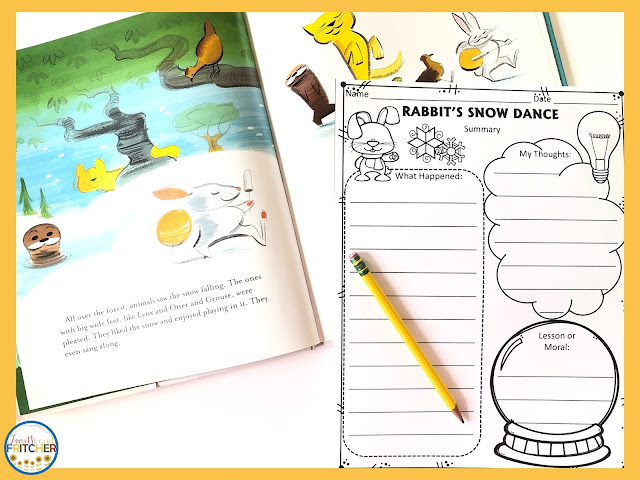
Rabbit's Snow Dance
Rabbit's Snow Dance; Summary Sheet

You can find find my print and go resource for Rabbit's Snow Dance HERE.

There are many read alouds for this picture book on the internet. Two options are listed below (the first link read aloud is more decorative with graphics and music, the second is a more direct and simplistic approach).

Read Aloud Rabbit's Snow Dance

Rabbit's Snow Dance


Other PRINT and Go Picture Book Resources:

American Revolutionary War Stories BUNDLE


Other Picture Book Blogs:


Easy Back to School Picture Books

Easy Lesson Plans

easy lesson plans elementary classroom

I've written thousands upon thousands of lesson plans during my career. I've been at this game so long that when I started teaching we didn't list actual standards within our plans; we simply stated the goals and objectives. Alphanumeric standards weren't required or included. That all changed with the implementation of the Common Core and teacher evaluation systems.

Lesson plans today have taken on a life of their own. Along with standards, teachers are sometimes expected to incorporate other detailed components for every lesson: minute-to-minute time stamps, dialog, specialized questioning, accommondations/modifications, etc... Some lesson plan templates introduced to teacher candidates are 10 pages long! No one working in the trenches has the time to write (or read) a 10 page lesson plan. 

To balance out the simplistic lesson planning I used once upon a time with the overly-rigorous plans being introduced today, I suggest using the 4Ts. If you focus on the four Ts, you will have planned for all the major components of what makes a great lesson.

The 4 Ts are:
  • Target
  • Text
  • Task
  • Talk

Target

What is the standard? What is the ultimate goal for this lesson? That is your target. 

Granted, lessons can be crafted that work toward more than one standard. However, keep your eye on the one standard that is most important. It will help you zero in on the most critical aspects of your lesson.

Keep in mind that mastery of all standards is expected at the end of the school year. Thus, if your students are unable to perform at the proficient level at the beginning of the year - that is expected. My expectations for R4.1 in September are vastly different than in June.

If your district has designated "priority" or "focus" standards, incorporate them into your plans often. Create lesson plans that move the focus standards in and out of the spotlight of the lesson. They may not always be the main component of your lesson, but are always being worked toward.

Text

What are the students going to read/watch/examine? What is going to be the vehicle for the learning? That is the "text". 

Most of the time we use fiction and nonfiction passages to guide student learning. But, we know that there is a vast array of choices now. Perhaps you will be watching a BrainPop video or moving students through a NearPod. 

Delivering content is no longer reduced to turning to page 73 in a text book.

Are you dissecting owl pellets? Examining slides under a microscope? Designing and building STEM roller coasters? Whatever you use to deliver the content, think of that as the "text". 

Task

What is the expected outcome of your lesson? What are students expected to produce? What will you be looking at in order to determine the next lesson? That is the task.

Just as standards can move in and out of the "top spot" in lesson planning, so too can tasks. Realistically, there are several tasks we expect students to perfrom for any given lesson. Many expectations fall within executive function skills sets and oftentimes are not thought of at all. Organizational skills or computer savvy are sometimes taken for granted. 

However, if students do not have the organizational or computer skills required to fulfill the task, you may be setting up a scenario that leads to frustration for you and your students.

Build up the skill sets required for the ultimate task. Make certain you have explicitly taught your students how to move through a Nearpod before you expect them to navigate and respond to one independently. Ask yourself if your students know how to open and edit a Google Doc or Slide before you assign a task connected to using the technology.

Make a concerted effort to eliminate confusion about how to complete tasks before you expect independence with a task. We cannot expect students to demonstrate command of a standard if they are unable to navigate the tech to do so. A little planning and explicit teaching at the beginning will foster smoother and easier task completion later on.

Talk

Who will be doing the talking during your lesson? Who is sharing information? How will thoughts and ideas be communicated? What will the conversation look like? That is the talk. 

If the bulk of your plan involves only your voice, consider adding to the plan. As teachers we sometimes fall into the trap of being the only voice in a classroom. But, we know that students need time to speak to each other. Some of the best learning comes from their peers and the ability to flesh out their ideas as they learn new material and find ways to anchor their learning in their brains.

Aside from the usual speaking skills that educators typically think of when writing their plans, how else can your students "talk" with one another? In a digital world that might mean using Jamboards, polls, or shared Slides/Docs. Any vehicle that encourages students to share ideas with one another is a means for them to "talk"; the more vehicles for communicating, the better.

Make time in your lesson for students to communicate with each other. Move beyond the minimal "turn and talk" scenarios and truly consider how you can allocate a good chunk of the lesson to students digesting and discussing the material amongst themselves.

The Other Stuff

Within a 4T lesson plan are things such as the date, subject, materials, exit, etc... Those pieces are important too. However, if the bulk of your brain power is concentrated on the 4Ts you will have a carefully crafted lesson that will engage your learners and lead to mastery of the most challenging standards out there.

If you would like a free 4T lesson plan template click HERE.


easy lesson plans elementary classroom